

Vacuum vs Vaccum: Which Spelling Is Correct?
Vacuum is the correct spelling. “Vaccum” is a misspelling, not a regional variant or an older form. The word has one c, two u’s and ends in m, and it is spelled exactly the same in American and British English. If you spotted vaccum in a draft, replace it with vacuum.
That settles the vacuum vs vaccum question in one line. The rest of this guide shows you how to remember the spelling, which forms of the word exist (vacuumed, vacuuming, vacuums, vacua), where the typo likes to hide, what “in a vacuum” means and how to pronounce the word.
Vacuum vs Vaccum: The Correct Spelling
The correct spelling is V-A-C-U-U-M: one c, then two u’s, then m. Merriam-Webster, Oxford Learner’s Dictionaries and the Britannica Dictionary all list the word this way.
Here is a hook that works: the doubled letter in vacuum is the u, not the c. The misspelling vaccum flips that, doubling the c and losing a u. Split the word into three chunks and the odd part stands out:
VAC + UU + M
If you remember where the double sits, you won’t make the mistake again.
Is Vaccum a Word?
No. Vaccum is an incorrect spelling of vacuum. You won’t find it as a headword in Merriam-Webster, Oxford Learner’s or the Britannica Dictionary, so treat it as a typo and fix it.
The error affects every phrase built on the word: vaccum cleaner should be vacuum cleaner, vaccum sealed should be vacuum sealed, and “vaccum the floor” should be “vacuum the floor”. Spell checkers usually catch it, but not always. If yours leaves vaccum alone, check whether the word was added to a custom dictionary by accident.
Is Vaccum a British Spelling?
No. Vacuum is the standard spelling in both American and British English. Oxford’s British and American pages carry the same spelling as Merriam-Webster and the Britannica Dictionary.
Unlike color and colour, or center and centre, this word has no regional pair. The only real transatlantic difference is vocabulary: British English sometimes uses Hoover, originally a brand name, as a everyday word for the appliance, while American English says vacuum or vacuum cleaner.
Does Vacuum Have One C or Two?
Vacuum has one c and two u’s. The full spelling is V-A-C-U-U-M.
The confusion comes from sound. Spoken aloud, the word runs together as roughly “VAK-yoom”, and the two u’s blur into a single sound. Writers who spell from memory tend to reach for the more familiar double consonant, which gives vaccum. Spelling by sound won’t save you here, so lean on the visual rule instead: don’t double the c, double the u.
Common Misspellings of Vacuum
The most common misspellings are vaccum, vacum, vacume, vaccuum and vaccume. Each one breaks the same rule in a slightly different way.
| Incorrect spelling | Correct spelling | What is wrong |
| vaccum | vacuum | Doubles the c and drops a u |
| vacum | vacuum | Drops one u |
| vacume | vacuum | One u, and ends in e instead of m |
| vaccuum | vacuum | Doubles the c |
| vaccume | vacuum | Doubles the c, drops a u and ends in e |
| vaccuming | vacuuming | Doubled c in the verb form |
| vaccumed | vacuumed | Doubled c in the past tense |
Why does vacume look tempting? English has plenty of words that end in -ume, such as volume, resume and consume, so the ending feels natural. But vacuum ends in -um, and no other letter follows the m.
What Does Vacuum Mean?
Vacuum means a space with very little or no matter in it. It also names the household cleaning machine, and it works as a verb and as a figure of speech.
The word comes from Latin vacuum, “emptiness”, which grew out of vacuus, “empty”. That Latin root explains the unusual double u. English dictionaries date the noun to the mid-1500s.
Vacuum as a noun
As a noun, vacuum has three main senses: a space emptied of matter, a vacuum cleaner, and an absence of something. Oxford describes the strictest sense as a space with nothing in it, not even air. In everyday speech, “I need a new vacuum” almost always means the appliance.
Vacuum as a verb
As a verb, vacuum means to clean a surface with a vacuum cleaner. “She vacuumed the stairs while the kettle boiled.” The verb forms are covered in detail below.
Vacuum as a figure of speech
Figuratively, a vacuum is a situation where something or someone important is missing. The classic example is a leadership vacuum, which appears when a leader leaves and no one has stepped in. Oxford also lists the phrase moral vacuum.
Vacuum in Science and Technology
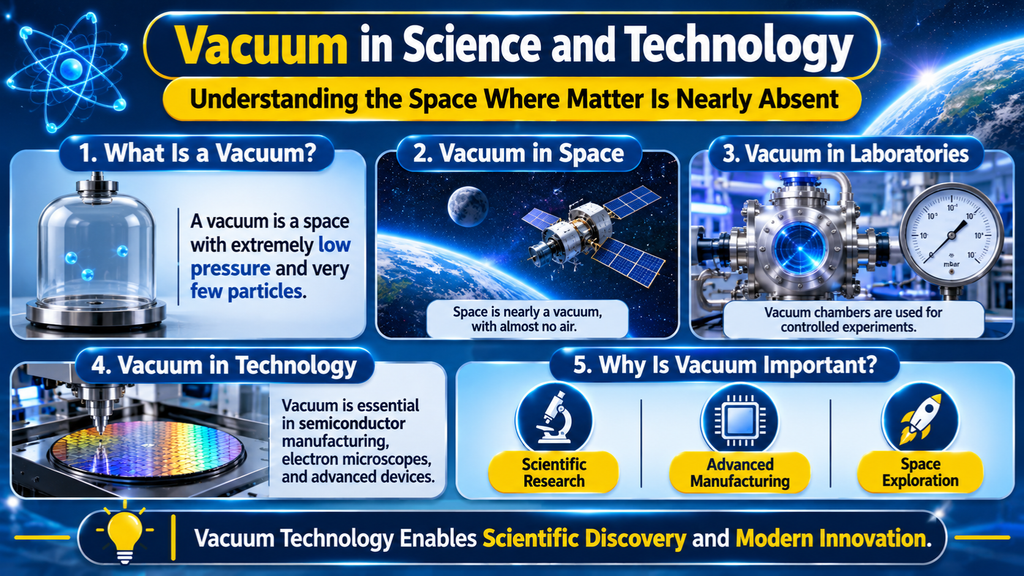
In physics, a vacuum is a region with far less pressure than normal air, and a perfect vacuum would contain no matter at all. Real laboratories work with partial vacuums, from rough vacuum to ultra-high vacuum, because removing every last particle is not achievable in practice.
The scientific story starts in 1643, when the Italian physicist Evangelista Torricelli filled a glass tube with mercury, turned it upside down in a dish and observed an empty space at the top of the tube. That experiment gave us the mercury barometer and a working idea of a sustained vacuum.
Today the word appears in many technical terms, and the spelling never changes:
- vacuum pump
- vacuum chamber
- vacuum tube
- vacuum gauge
- vacuum distillation
- vacuum packaging
- high vacuum
A vacuum tube, for instance, is a sealed glass or metal envelope with the air removed so electrons can travel between electrodes. A vacuum chamber is a sealed enclosure used to test materials or equipment at reduced pressure. In every one of these terms the word keeps one c and two u’s.
Vacuum Cleaner and Related Expressions
A vacuum cleaner is an appliance that cleans surfaces by suction. Merriam-Webster dates the term to 1903. People often shorten it to vacuum, and dictionaries record that shortened sense too.
A vacuum is a state (a space emptied of air), while a vacuum cleaner is the machine. In practice you will see both, along with a family of related phrases:
- vacuum cleaner bag
- vacuum cleaner filter
- vacuum hose
- robot vacuum
- vacuum seal and vacuum sealed
- vacuum flask
Every one of these keeps the standard spelling. Product pages are where vaccum cleaner tends to do the most damage, because a visible typo in a title or listing makes a store look careless.
What Does “In a Vacuum” Mean?
“In a vacuum” means in isolation, without regard to the surrounding facts, people or circumstances. Oxford lists it as an idiom for something that exists separately from other people or events when it should be connected to them.
The phrase is almost always used with a negative:
- “A policy can’t be judged in a vacuum.”
- “No company makes decisions in a vacuum.”
- “The results look different when you don’t view them in a vacuum.”
There is also a literal reading, where something really does happen in an airless space, such as a physics experiment inside a vacuum chamber. Context makes clear which meaning is intended.
Vacuum, Vacuums, Vacuumed, Vacuuming
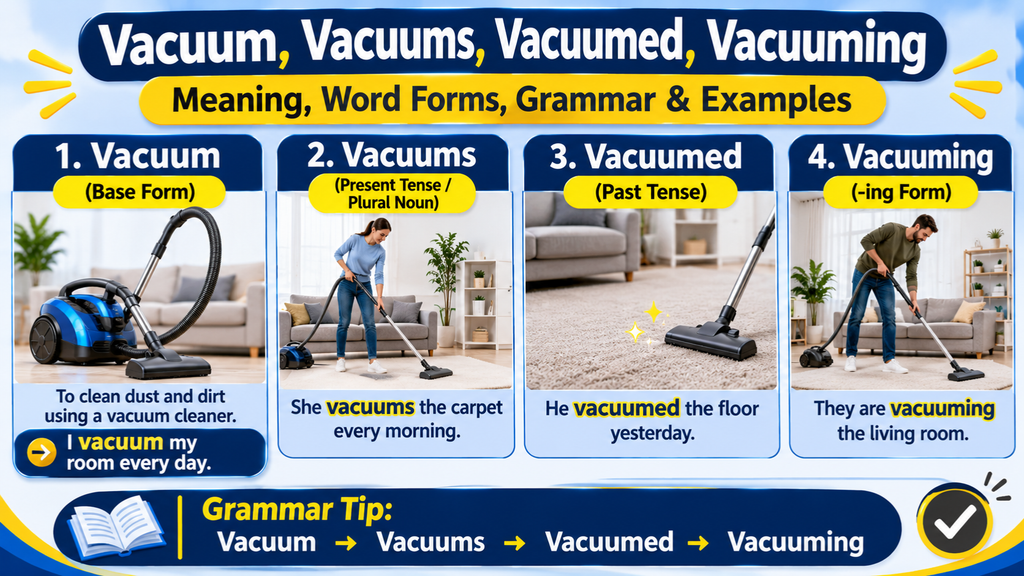
The verb forms are vacuum, vacuums, vacuumed and vacuuming. Merriam-Webster and the Britannica Dictionary list the same forms. The base spelling never changes, so you never lose a u or gain a c.
| Form | Example |
| vacuum (base) | I vacuum the living room every Friday. |
| vacuums (third person) | She vacuums before guests arrive. |
| vacuumed (past tense and past participle) | He vacuumed the car yesterday. |
| vacuuming (present participle) | They were vacuuming when the phone rang. |
What is the past tense of vacuum?
The past tense of vacuum is vacuumed. The simple rule is vacuum + ed = vacuumed. The same form serves as the past participle, so “I vacuumed” and “I have vacuumed” both use it. Writing vaccumed or vacumed is wrong.
How do you spell vacuuming?
Vacuuming is spelled V-A-C-U-U-M-I-N-G. Both u’s stay, and no letter is dropped or doubled before the -ing. “Vacuuming regularly keeps carpets fresh.”
Is vacuming correct?
No. Vacuming is incorrect, and so are vaccuming, vacumming and vaccumming. The correct form is vacuuming. The most common slip is dropping one of the u’s because the middle of the word looks too long.
What Is the Plural of Vacuum?
The plural of vacuum is vacuums. Merriam-Webster also lists vacua, the Latin-style plural, while the Britannica Dictionary gives vacuums. Wiktionary notes that vacua is rare outside some physics contexts.
| Plural | When to use it |
| vacuums | Everyday writing, appliances, general use |
| vacua | Physics and formal scientific writing |
Writing for a general audience? Use vacuums.
Where the Typo Hides
The vaccum typo shows up most often in technical and hobby writing, not in dictionaries or edited prose. Searching for the misspelling turns up threads about steam turbine condensers, CNC vacuum tables, jewelry casting, engine vacuum advance and robot pool cleaners. That is an observation from search results, not a statistic.
The technical terms themselves never change. A slip in the title of a post doesn’t alter the name of a vacuum gauge, a vacuum pump or the PostgreSQL VACUUM command.
That last one deserves a closer look. In PostgreSQL, VACUUM is a maintenance command that reclaims storage taken up by dead rows after updates and deletes. You will see it written as VACUUM, VACUUM ANALYZE and VACUUM FULL. One PostgreSQL mailing-list question writes “vaccum” in its first line, then lists the command variants correctly. That sums up the typo: it creeps in even when the right word is sitting on the screen. Because the command must be spelled exactly, writing it any other way will fail.
How to Pronounce Vacuum
Vacuum is pronounced /ˈvækjuːm/ (VAK-yoom), with the stress on the first syllable. Oxford Advanced Learner’s Dictionary gives the same IPA transcription for British and American English, so the two accents agree.
Merriam-Webster also records variants ending in -kyəm and one with an extra syllable, -kyü-əm. That small variation is the only real difference you will hear, and it is one more reason not to spell the word by sound.
Vacuum in a Sentence
- A perfect vacuum contains no matter at all, so sound cannot travel through it.
- I need to buy a new vacuum before the guests arrive.
- She vacuumed the stairs while the kettle boiled.
- He was vacuuming the car when the phone rang.
- The resignation left a leadership vacuum at the company.
- The engineer checked the vacuum gauge before restarting the pump.
- The database administrator ran VACUUM on the table.
- Don’t judge the plan in a vacuum.
Frequently Asked Questions
Is vaccum a word?
No. Vaccum is an incorrect spelling of vacuum. It is not listed as a headword in Merriam-Webster, Oxford Learner’s or the Britannica Dictionary.
Is it vacuum or vaccum?
Vacuum. One c, two u’s, ends with m.
Does vacuum have one c or two?
Vacuum has one c. The doubled letter is the u, so the spelling is V-A-C-U-U-M.
Is vacuum an English word?
Yes. Vacuum is a standard English word used as a noun, a verb and in compounds such as vacuum cleaner and vacuum chamber. It comes from Latin vacuum, “emptiness”, from vacuus, “empty”.
Is vaccum a British spelling?
No. British and American English both spell the word vacuum. The two varieties differ in vocabulary (Hoover versus vacuum cleaner), not in this spelling.
How do you spell vacuumed and vacuuming?
Vacuumed and vacuuming. Both keep the double u and have a single c. Forms such as vaccuming or vaccumed are wrong.
Is vacuming correct?
No. The correct spelling is vacuuming, with two u’s.
What is the plural of vacuum?
Vacuums works everywhere. Vacua is a Latin-style plural that appears mainly in physics.
Is a vacuum the same as a vacuum cleaner?
Not quite. A vacuum is an empty space, while a vacuum cleaner is the appliance. In casual speech, people shorten the appliance to vacuum, and dictionaries record that sense too.
Is the PostgreSQL command VACUUM or VACCUM?
VACUUM, with two u’s. Any other spelling will fail to match the command name.
Final Thought
In the vacuum vs vaccum debate there is only one correct spelling: vacuum, with one c, two u’s and a final m. Vaccum is a typo, never a variant. Keep the rule VAC + UU + M in mind, keep the same spelling in vacuumed, vacuuming and vacuum cleaner, and use vacuums for the plural unless you are writing physics. Before you publish, run a find-and-replace for the wrong spelling in your documents and double-check your spell checker’s custom dictionary.

2 Comments